
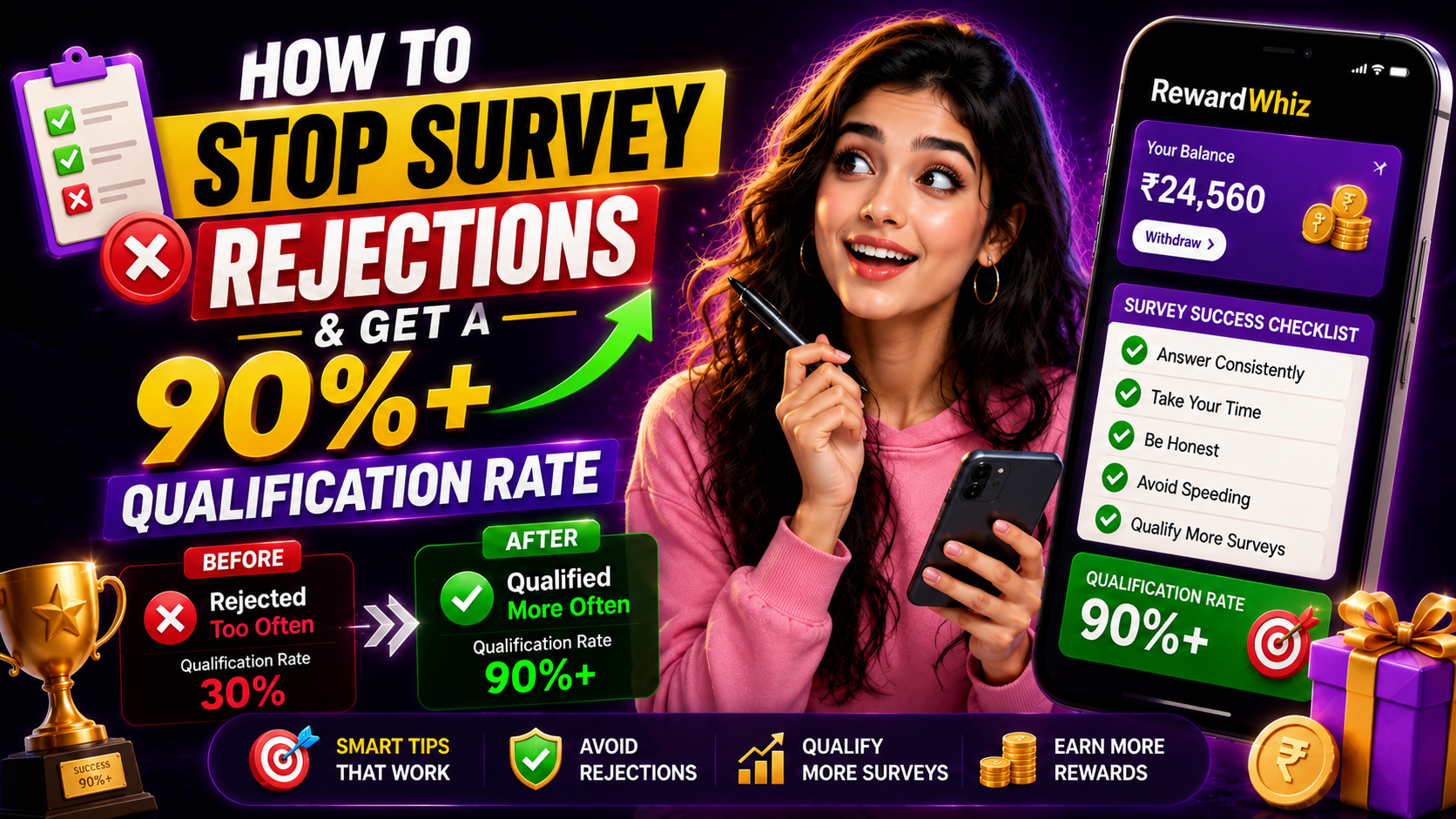
The Frustration That Kills Survey Earning
Picture this: You open your survey app, see a new survey worth ₹150, tap to start, answer 3 screening questions, and then... "Sorry, you don't qualify for this survey." This happens 4 more times. After 20 minutes of rejections and zero earnings, you close the app in frustration.
Sound familiar? You're not alone. Survey rejections are the single biggest reason people abandon survey earning. In our analysis of Reward Whiz user data, 67% of users who quit within the first two weeks cited "too many rejections" as their primary reason.
But here's the thing: experienced survey earners on the same platforms, seeing the same surveys, qualify for 80–90% of the surveys they attempt. Beginners qualify for only 30–40%. The difference isn't luck — it's knowledge. And by the end of this article, you'll have that knowledge.
How Survey Screening Actually Works (The Technical Reality)
Before diving into fixes, you need to understand what happens behind the scenes when you start a survey. This knowledge alone will reduce your frustration by 80%.
The Screening Process
Every survey has a target audience specification defined by the company paying for the research. This specification might look like:
"We need 500 responses from women aged 22–35, living in Tier 1 Indian cities, who have purchased skincare products online in the last 3 months."
The first 2–5 questions of every survey are screening questions designed to check whether you match this specification. They might ask your age, gender, city, and recent purchases. If your answers match the specification → you proceed to the full survey and earn the reward. If they don't match → you're screened out.
Critical insight: A screen-out is not a rejection of YOU. It's the survey finding that you're not in its target audience for THIS specific study. It's like a clothing store looking for size Medium models — if you're size Large, you don't qualify, but there's nothing wrong with you.
The Quality Score System
Beyond demographic matching, platforms maintain a quality score for each user. This score is influenced by:
- Consistency of answers: Do your responses to similar questions remain consistent?
- Completion rate: How often do you finish surveys you start (vs. abandoning mid-way)?
- Speed patterns: Do you answer at a natural reading pace or suspiciously fast?
- Attention check performance: Do you correctly answer trap questions designed to catch inattentive respondents?
Your quality score determines two things: which surveys you're shown (higher score = more premium, higher-paying surveys) and whether borderline qualifications are accepted.
Reason #1: Incomplete or Outdated Profile
The Problem in Detail
Survey platforms use your profile data as the first matching filter. If a survey targets "25–35 year olds in Mumbai who use Android phones," the platform checks your profile before even showing you the survey. If your profile says age: blank, city: blank, device: blank — the platform can't match you, so it either doesn't show you the survey at all or shows it and lets you get screened out on basic questions.
In our data analysis, users with less than 60% profile completion received an average of 3 survey invitations per day. Users with 100% profile completion received 9–12 survey invitations per day. Same platform, same demographic, 3–4x difference based purely on profile completeness.
The Fix (Step by Step)
- Go to your profile settings right now
- Fill in every field, including "optional" ones.
- Be precise: Don't select "India" for location — select your specific city. Local brands target specific cities.
- Be honest: If you're a student, say you're a student. Lying about being a "business executive" won't get you more surveys — it'll get you surveys you immediately get rejected from.
- Monthly update: Set a calendar reminder to review your profile on the 1st of every month. Job changes, purchases, new interests — all of these affect your survey matching.
Reason #2: Inconsistent Responses
The Problem in Detail
Survey quality algorithms are more sophisticated than most users realize. They don't just check individual answers — they cross-reference answers across the entire survey and even across multiple surveys over time.
Within-survey checks: Question 5: "What smartphone brand do you use?" → Samsung. Question 18: "Which of these brands have you used?" → You don't check Samsung. Result: Inconsistency flagged. If this happens 2–3 times in one survey, it's automatically rejected.
Cross-survey checks: Last week's survey: "Household income: ₹3–5 lakh/year". This week's survey: "Household income: ₹10–15 lakh/year". Result: Inconsistency flagged. Quality score reduced.
The Fix
Always answer honestly. This sounds simple, but many users try to "optimize" their answers by guessing what the survey wants to hear. This backfires because you can't maintain a false identity consistently across dozens of surveys, and algorithms are specifically designed to catch this. One caught inconsistency can reduce your quality score for weeks. If you genuinely don't remember an answer, take 10 seconds to think before selecting. A thoughtful honest answer is always better than a quick random one.
Reason #3: Answering Too Fast
The Problem in Detail
Every survey has an expected completion time based on the number and complexity of questions. A 15-minute survey completed in 2 minutes raises an automatic red flag — the system interprets this as either bot behavior or random clicking without reading.
The threshold varies by platform, but generally: completing a survey in less than 40% of the expected time triggers an automatic quality review. Completing it in less than 25% typically results in automatic rejection.
The Fix
Aim to complete surveys in 60–80% of the stated time. For a "15 minute" survey, spend 9–12 minutes. This gives you room to read questions properly while still being efficient. Read each question fully before answering. Don't just scan the first few words and guess.
Reason #4: Demographic Mismatch
The Problem in Detail
This is the most common screen-out reason, and unfortunately, it's the one you have the least control over. If a survey targets mothers aged 30–40 and you're a 22-year-old male student, no amount of strategy will help you qualify.
The Fix
While you can't change your demographics, you can minimize time wasted on mismatched surveys by using platforms with pre-matching algorithms. Reward Whiz, for example, checks your profile against survey requirements before showing you the survey. This means most surveys in your feed are ones you're likely to qualify for, dramatically reducing screen-out rates compared to platforms that show you everything.
Reason #5: Using the Wrong Platforms
The Problem in Detail
Many globally-focused survey platforms have thin inventory for Indian users. They show you a list of 20 available surveys, but 15 of them are geo-restricted to the US, UK, or EU. You attempt them, get screened out immediately, and count them as "rejections" — when really, you never had a chance to begin with.
The Fix
Prioritize platforms built specifically for the Indian market or with strong Indian survey partnerships. Reward Whiz curates its survey inventory specifically for Indian demographics, which means virtually every survey you see is one that Indian users can potentially qualify for.
The Complete Rejection-Reduction Checklist & Expected Results
- ✅ Profile 100% complete (every field, including optional ones)
- ✅ Profile updated monthly (income, interests, job, city)
- ✅ Always answer honestly (no gaming, no guessing what they want)
- ✅ Spend 60–80% of stated survey time (no speed-running)
- ✅ Read attention check questions carefully ("Select Disagree for this question")
- ✅ Use India-focused platforms as primary (Reward Whiz recommended)
- ✅ Check surveys during peak hours (9–11 AM and 6–8 PM for best availability)
- ✅ Don't take rejections personally (they're targeting, not judging)
| Metric | Before Fixes | After Fixes |
|---|---|---|
| Qualification Rate | 30–40% | 70–90% |
| Surveys Completed/Day | 1–2 | 4–8 |
| Daily Survey Earnings | ₹20–₹60 | ₹100–₹300 |
| Time Wasted on Rejections | 60–70% | 10–20% |
The compound effect of these improvements is dramatic. Going from 2 completed surveys/day to 6 completed surveys/day doesn't just triple your income — it also triples the speed at which your quality score improves, which further increases your survey availability. It's a virtuous cycle that accelerates over time.
Ready to start earning? 🚀 Download Reward Whiz today and put these strategies into action!